

A recent letter to the editor of Canadian Architect magazine inspired me.1 I am inspired by a quirky moment in the intent and message of the letter. I do not know if this letter as published is the direct intent of the author of the letter, nor how much it and its intent are due to the magazine's editors. I do not define where or who the final form of this letter actually comes from. I am reading it as it stands in the hard copy publication.
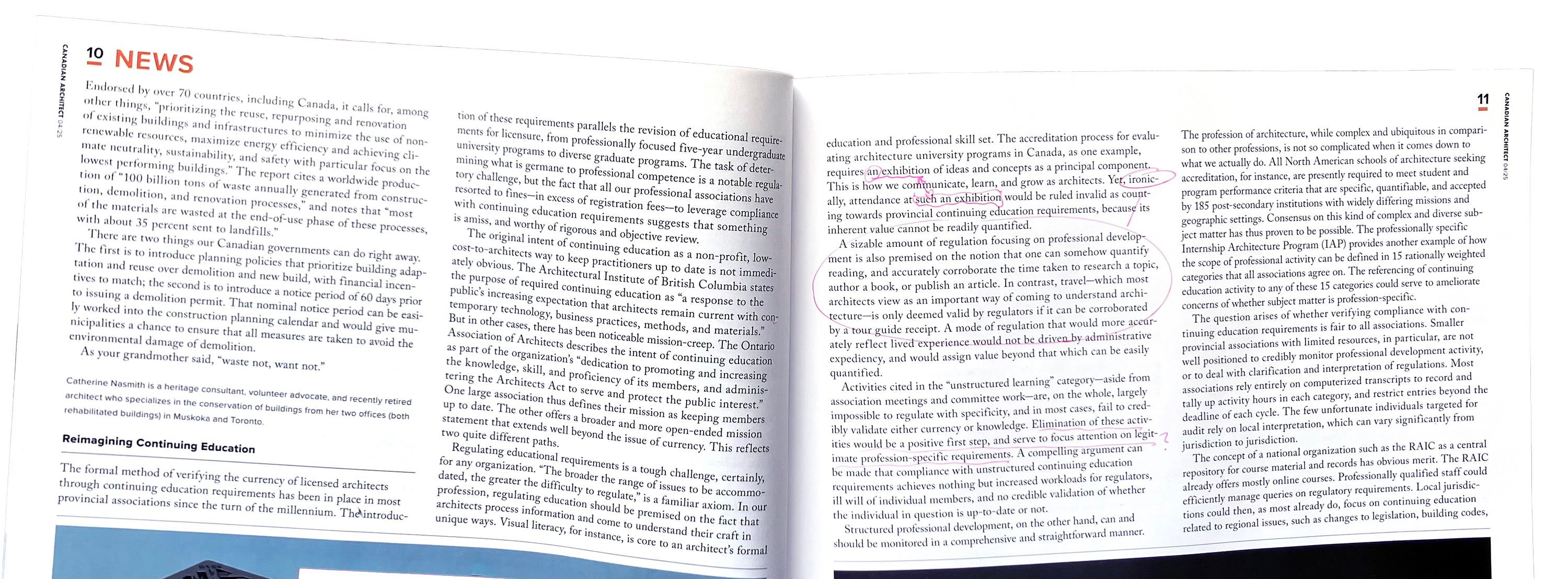
The letter entitled Reimagining Continuing Education letter reflects the state of affairs to me, even if it is inadvertent. The text takes on issues in continuing education, a topic that is superficially plain and logical, and is not really in need of presentation in such a magazine. It is certainly not new and is hardly a ‘reimagining’ at all, actually. It is not controversial beyond the level of perhaps stubborn bureaucrats troubling each other with differing approaches. It is unfortunately not controversial. It needs to be. The letter points to a core aspect of architectural practice is already weakened and needed, that the writer(s) wants removed.
What I am paying attention to is how the letter sets up an essential part of professional activity and to dismiss it. This article takes this as an opportunity to capture the value of architecture that is concealed in practice. This turns the letter to means to define a catalyst for advancing toward the profession's future and countering it malaise. It is a lack and an absence, and it is also 'concealing', a term that I use in my writing under the heading of The Goal in Architecture or G¡a here on Substack.
The letter makes its assertion, claiming a "compelling argument", that certain “[il]legitimate [non-]profession-specific” “unstructured continuing education requirements” should not be included. The dismissal of the core of the value of architectural practice in light of continuing education is revealed for a moment in this letter. In doing this the letter voices continuing support for the colonization of architecture by technology. The difficult to measure, or so-called '“unstructured” component, is what architects actually deal with as their work. In this letter we have the concealed grounds for architecture and its means bubbling to the surface born in a set of non-sequiturs that I will distill.
Part of the letter is quoted below, with selected statements italicized. The part that I quote has three true statements that contradict each other. My commentary, focused on the italicized text, follows.
Regulating educational requirements is a tough challenge, certainly, for any organization. "The broader the range of issues to be accommodated, the greater the difficulty to regulate," is a familiar axiom. In our profession, regulating education should be premised on the fact that architects process information and come to understand their craft in unique ways. Visual literacy, for instance, is core to an architect's formal education and professional skill set. The accreditation process for evaluating architecture university programs in Canada, as one example, requires an exhibition of ideas and concepts as a principal component. This is how we communicate, learn, and grow as architects. Yet, ironically, attendance at such an exhibition would be ruled invalid as counting towards provincial continuing education requirements, because its inherent value cannot be readily quantified.
A sizable amount of regulation focusing on professional development is also premised on the notion that one can somehow quantify reading, and accurately corroborate the time taken to research a topic, author a book, or publish an article. In contrast, travel-which most architects view as an important way of coming to understand architecture is only deemed valid by regulators if it can be corroborated by a tour guide receipt. A mode of regulation that would more accurately reflect lived experience would not be driven by administrative expediency, and would assign value beyond that which can be easily quantified.
Activities cited in the "unstructured learning" category-aside from association meetings and committee work—are, on the whole, largely impossible to regulate with specificity, and in most cases, fail to credibly validate either currency or knowledge. Elimination of these activities would be a positive first step, and serve to focus attention on legitimate profession-specific requirements. A compelling argument can be made that compliance with unstructured continuing education requirements achieves nothing but increased workloads for regulators, ill will of individual members, and no credible validation of whether the individual in question is up-to-date or not. Structured professional development, on the other hand, can and should be monitored in a comprehensive and straightforward manner.
The accreditation process for evaluating architecture university programs in Canada, as one example, requires an exhibition of ideas and concepts as a principal component.
"An exhibition" of ideas and concepts and visual ideas by students point to a core component of professional architects’ education that bears the core value of architectural practice. The architectural project and the review of it as participation in the public sphere, hence a multifaceted use of the word ‘exhibition’, is essential ground for anyone gaining a professional degree. An example of this public quality is that anyone could walk into the AA off Bedford Square in London, straight into a raucous crowd in a crowded room to view projects of Zaha Hadid’s studio. Maybe there are more controls on access now, but I could and did join such publics when I visited London through the 1990s and the early part of this millennium.
Yet, ironically, attendance at such an exhibition would be ruled invalid as counting towards provincial continuing education requirements, because its inherent value cannot be readily quantified.
This is an amazing turn where the student or architect exhibiting certain capacity in particular qualities is defined as merely visiting an exhibition. The term ‘exhibition’ is used to include this, as I noted. It is obvious that there is a big of difference to its use here, with minimal value, compared to the full potential of exhibition. The most important difference being that a viewer of an exhibition is not using their skills with something at stake to actively make and exhibit their decisions and skills at executing their planning.
This is where I question if there was an error in editing. Nevertheless, the letter continues in a way that makes this intent plausible.
A mode of regulation that would more accurately reflect lived experience would not be driven by administrative expediency, and would assign value beyond that which can be easily quantified.
This is the big ask of us. It can reflect that there is a dire need for the value that architects bring to our environment as a practicality that is lived. But we need to re-evolve, or begin again to evolve, what values architects' output supports. This is almost greenfield territory now. Questioning this matter that is not ‘easily quantified’ will show how we are remiss as a profession. We need to define what the values we look to serve are, including at a paradigmatic level and how to assess these fairly and consistently. Although the quoted sentence turns from the first definition of the ineffable and beautiful core of architecture in practice, one can root for the third assertion as being what we need to do, which we have needed to do for a couple generations now.
However, the letter turns with a radical statement.
Elimination of these activities would be a positive first step, and serve to focus attention on legitimate profession-specific requirements. A compelling argument can be made that compliance with unstructured continuing education requirements achieves nothing but increased workloads for regulators, ill will of individual members, and no credible validation of whether the individual in question is up-to-date or not.
There is a compelling argument that the remaining "legitimate profession–specific requirements" are not at all architecture. These commonly supplied by a great many non-architect professionals and businesses. The building technology, technological nature of fees, contracts and integration with the trades included in making the environments that architects plan, define our income and our financial value in practice, but they cripple the profession of architecture if they define practice. Thus, this letter becomes banal in the worst way. It is banality as Hana Arendt described it; that evil is banal. It is banal in this way because it asserts in a perfectly reasoned tone that we not be architects at all.
We maintain our value as architects because we develop "these activities" in their undefined but (for many of us) obligatory way into our practice, out of the education we get. Many of us bring that innately, feeling that this is truly what architecture is about when we begin our careers and choose the architectural profession. To state that a compelling argument to ignore or exclude this can be made is necessary only because this is like a guilty practicality. It is akin saying, 'We should be honest in life, but who can be honest these days, while so many of us are already dishonest?' We know that the real spirit of architecture is in the unmeasurable and unremunerated concealed core of practice. But the professional gets paid for the box (i.e. the building technology), not the apples in it. Many boxes are sold empty.
To call the attempt at bringing real core values of architecture into continuing education “[il]legitimate [non-]profession-specific” “unstructured continuing education requirements” is preposterous, actually. It is to go a step further, and to attempt to legitimize selling empty apple boxes by arguing that farming apples is ridiculous because so many of the boxes are sold empty now.
At this point the letter then turns the screw again by expressing continuing education as having a narrow function of being up-to-date. Continuing education is most certainly important as the utility of keeping pace with change and for maintaining functions that we may not be individually involved in for periods at time. But the higher value is to create a community of evolution for the professional. This fulfills the term ‘continuing education’ in the fullest sense. Continuing education should include future-orientated R & D on multiple levels, not just the results of R &D in technology. Development in architecture beyond the technological evolution has been facilitated through professional degree programs. It is often spurred by architects who teach in order that their research can proceed at all. The cost of architect’s work as borne as a function of the construction value of a project makes research of the fullness of architecture difficult. Developmental work for the profession that extends to the very paradigm of professional values happens through practice. This is not simply a cost issue, although we are not definitively remunerated for it now. We do not fund this because we conceal that value in the profession's technological structure, leaving “[il]legitimate [non-]profession-specific” “unstructured” architectural values not remunerated.
Continuing education can actually bear those unmeasurable architctural values that we must nevertheless either answer to or be deficient in, that are not directly part of measurable technological activity in practice now. Even beyond that, continuing education must join and enhance ‘advocacy’ to go beyond mere promotion to becoming the expression of architects and architecture’s ancient and essential role in the wellbeing of life and the public sphere. If advocacy were merely promotion, we could use that word.
The component of practice that is dismissed as "these activities" by the writer or editor of this letter bear the service and values of architectural practice that belong solely to the profession of architecture. This letter is an exemplary moment from within the dogmatic POV of our current professional culture of architecture’s value become a chimeric quality that so many of us dismiss. This is literally happening in the letter. This stated effort to regulate continuing education explicitly vanishes architectural value. Dismissing the essential component of providing architecture in the world cannot be rational. The letter perpetuates a series of non-sequiturs, again offering them as if they are new. It is blind habit and not new at all.
It could hardly be clearer how then current techno-profession is negligent in its support of architectural value. "These activities" that this letter devalues as illegitimate and non-professional are the core of the profession; they are its raison d’étre. “These activities”, these unmeasured attributes of life that we as architects are to give measure to. To make it clear, it is the making of measure, not the building, that we provide. “These activities” can be brought adjacent the regulated techno-bureaucratic professional paradigm to determine the crux of our serious issues in the profession.
Our public sphere still claims and recognizes that architecture exists in principle, for which I am grateful, even if what is claimed to be architecture is most often not. So we are safe because the term ‘architecture’ is still culturally meaningful. We are lucky that no one else is doing it.
The unmeasurable heart of architecture is concealed in the current technological context that professions in all nations propagate. If our profession wields the problem properly, architects' fortunes would rise along with the quality of the life and the world. We are all passing through this the moment; architecture is about this because this is how aspiration in human conscious life is clarified.
This question lies at the heart of movement toward a complete renewal of the profession. As a global issue, facing it will be widely beneficial. Who wants to step up?
Letters to the Editor: ‘Reimagining Continuing Education’ in Canadian Architect, April 2025 V.70 N.02, pp. 10-11.