


In the previous article, I introduced phenomenology and how it allows us to consider the essence of technology in terms that cohere with spirituality. Heidegger’s discussion on the essence of technology is a building block for this project. Phenomenology’s roots allow Heidegger’s work on the essence of technology to be linked with spiritual practice and its component values. Phenomenology’s origin in antecedent Indian Traditional Knowledge System (ITKS) allows us to bring yogic and other related Vedic practices parallel to architects’ practice for critical research. Technology’s profound relationship with spirituality and the evolution of consciousness allows us to reconsider the current architectural techno–profession in light of its service to provide architectural value.
The goal of the architectural program.
To reveal the grounds and outcomes for architecture’s future through the Verknüpfung of spiritual and architectural practices we need to better define the goal in practicing architecture. Our supposition and intuition is that architectural practice might have supporting the goal of spirituality as the aim that creates architecture.
Aspiration at the level of life’s value is a universal factor that unfolds like a blooming flower. Questioning what professional practice needs to be to realize environments that presence architecture as this aspiration requires that we can provide a way to connect with the goal of this aspiration. Support of this goal is the essential program of architects preparing architecture where architecture is based on presencing the experience of awareness of aspiring that goal at a place.
Preparing an environment to presence architecture operates in a human made interlinkage with matter, science, technology and the objective environment. Every architect feels the special value of environments beyond ‘bricks and mortar’. The knowledge, skill, and competence of how we make environments today can be enabled with a practical solution–set for its evolutionary blossoming. I envision that, while the profession remade itself with technology, we will remake technology.
Architecture’s presencing according to anyone’s capacity for each of us, one by one, is far less fixed than the building, yet it is just as definitive. Material arrangements in nature and our activity have a different trajectory than the technology of architectural practice. Human nature and the goal of life within each user’s awareness are always a component to architecture’s presencing. These are distinct, but not separate.
Architecture presences through individual values, while it is embedded in the aspiration we all have together. The architecture that we provide ourselves to live with is personal, in the context that community, society and the cultural spaces we create. Its value is, in short, always part of the public sphere. Architecture is broad and whole, serving everyone individually, in spheres that extend beyond our perception.
As one evolves personally and identification with the goal intensifies, the point of view changes the path’s characteristics and the apparent goal. Personal awareness and values transform. More realms of connectivity may become conscious experience. Even people who have evolved themselves and gained greater spiritual conditions, and who may have enormous capacity, still benefit from architecture to support life and reduce burdens; perhaps even more so than others.
To develop architectural practice that provides environments that presence aspiration for the goal of life, that goal must work for awareness on any possible point of the spectrum for anyone.
A Spiritual Practice
Spiritual practices’ purpose is for individuals to evolve their consciousness, and develop awareness, sensitivity and capacity. The various models support a range of approaches. Spiritual practices that are properly formed and utilized can form a life that supports our goal of life.
Spiritual practices and paths have history that vanishes into the mists of time. Our earliest documentation found it already in full swing. Some lines of spirituality end or are broken. Some methods or practices may over time become irrelevant or devolve to worship and dogma, and fade out of practical use. Some evolve continuously to hold their core offering. New research pushes the origin of Vedic texts to earlier than 10,000 BCE.1 For the past 2000 years as religions have held sway, while simpler practices for self attainment upon which they are all based are obscured.
This project is grounded in what can be done in practice now, taking up an extant stream of spiritual knowledge that has grown on giant roots formed a long time ago, to make accessible the giant foundation of our antecedents. A current practice of merit that values and honours that history may use terms that as yet have no current equivalent; an issue due to the massive shift of modernity. What can be done now engages what might seem to be of the past, but if it can be practiced now, it becomes contemporary. Such a spiritual practice, held adjacent to architectural practice, will allow us to use the verknüpfung of architectural practice and spiritual practice to form our approach.
Heartfulness/Sahaj Marg
A spiritual practice that meets today’s needs is Sahaj Marg Yoga, part of the Heartfulness movement. A ‘marg’ is akin to a path as a place to move along, but has the nuance of a way that is made with movement through transcendent potential with our aspirational capacity. ‘Sahaj’ carries the meaning of ‘easy’ as simple in the way of nature. This practice has been formed within the span of the Machine Ages and is intended to function from this time. It has a clear description of the goal of life that is based in spiritual practice.
It is rajayoga, a term attributed to Swami Vivekananda2, which focuses on the components of the yogic Eight Limbs, or ashtanga. These are concentration (dharana), meditation (dhyana) and samadhi. Yoga’s antecedents reach back before Buddhism, before the Hindu religion, Christianity and the ancient Greeks, cohering with millennia of transformative evolution. It uses the same introspective meditation practice that inspired phenomenology. How the elements of the practice fit in our time can be verified through the living guide, with experience, and how it reflects the documentation of its antecedents. It is broadly verified in the experience of thousands of people through the many related practices that are required by human diversity. It is a living practice that spans time and humanity as a unity, as does architecture.
Sahaj Marg rajayoga serves to define this project’s supposition of a goal with a clear structure and terms with numbers, form and concept. It is part of ITKS, which includes architectural practice, called vāstu, along with aryurvedic healing practice, cosmology and others. The program of this spiritual practice and architectural practice is interwoven with the essence of consciousness and aspiration and gives form through the available knowledge of its culture and literature, to express knowledge is available to the practicing architect.
A Goal in Practice
A description of the goal in spiritual practice is provided by Ram Chandra Maharaj (Shajahanpur), who presided over the making of the practice of Sahaj Marg. The following are key descriptive statements of the goal in the first chapter of Reality at Dawn reference personal transformative evolution and point to what may be obscure or concealed within religious forms, their politics and social and cultural power. This describes extents for the aspiration for a goal of life.
Beginning our march from the outer most circle we proceed towards the centre crossing each circle to acquire the next stage. [...] In the diagram the state of liberation lies between the second and third circles. [...] This may help [...] form a rough idea of what still remains to be achieved [...] [The fifth circle] is the stage of Avyakti Gati (undifferentiated state). At this stage a man is totally free of the bounds of maya. [...] The region of Heart [...] is now crossed and now we enter the Mind Region, after crossing the fifth circle. The eleven circles after this depict the various stages of egoism. [...] By the time we reach the sixteenth circle we are almost free from egoism. The condition at this stage is almost inconceivable [...] What remains when we have crossed this circle is a mere identity which is still in the gross form.
We now enter the Central Region. There too you will find seven rings of something. I may call it light for the sake of expression [...] The form of dense identity, as I have called it, grows finer and subtler to the last possible limit. We have now secured position near-most to the Center and it is the highest possible approach of man. There we are in close harmony with the very Real condition. Complete merging with the Center is, however, not possible, so as to maintain a nominal difference between God and soul.
Such is the extent of human achievement which a man should fix his eyes upon from the very beginning, if he wants to make the greatest progress on the path of realization. [...]
The words, the circles and the diagram are hints. The circles are rings or spheres and can be said to be realms for the purposes of one thing leading to another in evolving spiritual conditions in the individual. They are like areas ‘within’ us that are subtler than the body and they can be felt. They are the known unknown that becomes what we are as we gain access. The ‘Central Region’ is ALL, everything, the ‘Ultimate’. It is also utterly without attributes, hence the traditional term ‘nothingness’ since it is not nothing. It is a point and a small circle in the diagram and it is all encompassing and infinite The difficulties in thinking it are the limits of thought manifest. Difficult, yet, considering it is better than not.
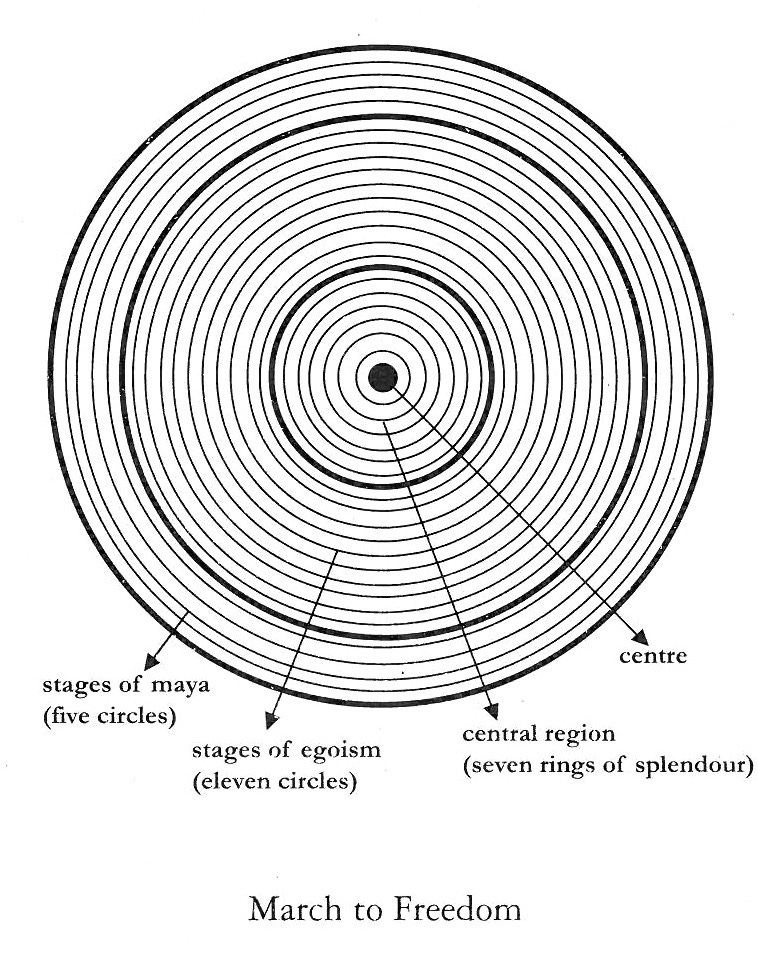
Sri Ram Chandra of Shajahanpur’s (Babuji) ‘March to Freedom’ diagram, from Reality at Dawn. p. 19.
The following statements guide the five parts of G¡a. It is a structure to be taken as layers to fulfill the development of qualities that set up the relationship of the practicing architect in Verknüpfung with spirituality. Each associates a facet of the expression of what is needed. The stages for this series of articles are organized accordingly. The further articles of this series grows from them. The whole will become clear as the flow of these articles continues.
PART.I. Goal
The aims and objects of life conceived in terms of worldly ends are almost meaningless.
PART.II. thought.
We forget that pains and miseries are only the symptoms of a disease but the disease lies elsewhere. […]
PART.III. technology.
The goal of life means nothing but the point we have finally to arrive at. It is in other words, the reminiscence of our homeland or the primeval state of our present solid existence, which we have finally to return to.
PART.IV. devotion.
It is only the idea of destination which we keep alive in our minds and for that we practice devotion only as duty. Duty for duty’s sake is without doubt nishkam karma (selfless action) and to realize our goal of life is our bounden duty.
PART.V. Profession.
Now I come to the point what our real goal of life should be. It is generally admitted that the goal must be the highest possible limit of human approach. ... The final point of approach is where every kind of force, power activity or even stimulus disappears and a man enters a state of complete negation, Nothingness or Zero.
Starting Point
This is a starting point. Reassessing architecture in light of spirituality is like jumping up onto a carousel. The action and the intention define the course; neither came first. Both came first — while something else also came first. We are focused on the goal.
Sahaj Marg rajayogic practice is a good representative of spiritual practice. It serves by being complete, current, and founded on millennia of humanity’s aspiration.
An architectural project is about making true a form chosen to fulfill an aspiration at a place. G¡a is akin to an architectural project to inform a way to practice in the world as an architect, although it is written. The five statements initiate five PARTs of making this project true as an instance of dwelling. It is an aspiration, that moves on to aspire the architectural profession that might serve a human goal that is ever unfolding. The goal is our aspiration as we design our destiny in spiritual practice. How our environment supports and serves this is architecture.
The initiation begun by Husserl’s inquiry is remade as an inquiry into technology’s essence by Heidegger and linked to architecture by Christian Norberg-Schulz. This is a practical component of this series to provide the grounds for the profession of architecture to develop anew its own terms again.
This concludes the PART.I.Goal. There are assumptions and assertions that create an assemblage that is put up against the profession of architecture as we know it.
Vedveer Arya is an Indian civil servant and researcher whose aim is to update the chronology of Indian history using scientific method. His work can be found on academia.edu.
Swami Vivekananda, Rajayoga. In the latter part of the 19th century he came to the United States and introduced yoga and the concept of universal spirituality according to Indian Traditional Knowledge at the Chicago World Fair’s Conference on Religions.