


PART.I Goal.4 is in 3 parts that form an organization of salient points centred on aspiration and architecture.
Goal.4A defines aspiration in practice of spirituality and architecture.
Goal.4B introduces phenomenology for the re–appropriation again of architecture’s program and value in the profession.
Goal.4C introduces how yogic practice and its antecedent Indian Traditional Knowledge System (ITKS), links to aspiration and phenomenology, and informs architectural practice.
Phenomenology, as Heidegger’s exploration of technology and Christian Norberg-Schulz on architecture, allows the description of a space to link spiritual and current architectural practice. The third article defines a practical definition of the goal. These three are definition, direction and goal in that order for redeveloping the program of architecture.
A practical way to work with with the supposition of the Verknüpfung of spirituality and architectural practice is needed. We need a way to include that there is more to each of us than we know perceptually, factually and tangibly that influences objects, other people, and systems that appear to be external to us. Whatever a person does participates in the whole and all life in Nature through multiple layers of energy and dimensions. We need to knowingly include this unknown in professional architectural practice. There is no architecture without understanding the goal in life.
Architecture does not exist without all of us, and we all participate in human mind and consciousness. Architecture is every POV that people may have. Each of us is a facet of the whole, and we are each expressions of the whole. These facets are like a cut gem, each providing a particular angle into one and the same thing. I use names for them such as the ‘public sphere’ and ‘egregore’, as well as culture and society. You and I are also each a facet, with a name.
To rise personally is to aspire. All of us aspire. We are a field of aspiration. Aspiration looks different in each of our lives. Yet, at heart, it is one impulse, common to us all. Architecture is also the absolute presence of aspiration in all of us. Architecture has no presence without this. Each practicing architect develops their awareness to bring meaning in built or otherwise directed environment–making. That is also driven by aspiration. Therefore, there are two sides to being a practicing architect.
Our individual approach to aspiring the revelation of ‘Reality’, and of evolving ever further, and
that it be impersonal: Einstein (allegedly) once said, ‘To rise above the merely personal’ is needed to create art. ‘Art’ is too narrow to contain architecture, but the need to work ‘beyond the merely personal’ is essential to preparing architecture.
Inquiring into one’s nature is essential and is original. We naturally aspire the advancement that comes through self–inquiry. One way or another everyone must do it. Architecture is a function of this. Architecture is aspiration in the public sphere formed of experience in the world, which is only available through our inner awareness.
Spirituality is to work on one’s self intentionally, whatever one’s awareness and their culture’s advantages and limitations, engaging that aspiration. Spiritual practices have attributes that interact with and link our aspiration to our environment through dwelling. The characteristics and knowledge base of a spiritual path can inform the practice to provide for architecture.
Aspiration in practice.
A practical approach that includes both spirituality and architecture includes that the practicing architect also aspires greater conscious awareness. The architect in practice is as an individual upon whose knowledge and awareness the work depends.
Our environment is always in Nature. It manifests our human consciousness. Architecture is thus component to Nature. We add to Nature with the public sphere, the egregore of humanity, as representative of humanity in Nature. Architecture serves spirituality and wellbeing as part of Nature through human conscious awareness.
Knowledge of the goal in life is attained in our dependency on living life and is got in life’s living. Everyone does not first need to be completely aware of that aspiration for it to be effective in order to experience architecture and know what architecture is. We are born into that condition. Awareness of that advances with the development of one’s faculties. The narrow learning that we are mainly taught in schools does not in principle support this. It sadly convinces a lot of people very early in their lives that there is nothing there. With growing awareness, spiritual evolution and the aspiration for practice increases.
Yoga, a part of the Indian Traditional Knowledge System (ITKS), holds that the goal of reaching the ultimate condition is an infinite process. That could mean that getting nearer to the goal is not possible. It feels as if we do get nearer though. I may not know everything, but I do eventually know more. Rather than measured distance, (nearness to) the goal is known according to capacity. Knowledge seems to change due to what we perceive. Or, we can say human life is unreal and we seek to transcend it. This is not generally called ‘learning’.
Seeds have nothingness ‘inside’.1 A seed may sprout in a particular place and it defines how the sprout grows and how it propagates. The variations in its growth are infinite, yet it is one thing. A seed extends immeasurable qualities with infinite variability from an unknown origin, going back to an ‘ultimate’ origin, anchored in the single materialized being, like a seed or the tree that has nothingness inside.
The infinite and the finite are integrated in life. Architecture is a natural integration that we organize, or do we create it? It is measurable and infinite with parameters that have extensions, ramifications and further vectors, on and on toward infinity.
Our life is like a seed. Architecture presences aspiring awareness in the form of environment. Architecture is infinite potential, and unknown, unmeasurable ‘nothingness’ is made as a finite thing; as measure. As a seed, or tree … or a human.
Architectural projects are not objective scientific answers or solutions. Many architects use that concept to make their students and clients do what they want. But it’s not true. Experience in practice shows that developing an architectural project is a matter of making it work and making it true, and it is not akin to scientific finding of an objective truth. A typical built environment must refer to scientific and technological facts and literally haptic solutions for the construction of the physical thing.
Scientific facts are true. Institutions form under the support of the authority of scientific outcomes; each has a halo of derived power. Institutions power their importance with scientific facts. They may take that power beyond their remit. Their power in social, political and educational institutions may allow them to dispense with actual facts, they may exclude models and reduce broader or more nuanced results for ease of consumption to serve powerful institutions or popular wishes. This might seem to be a bad thing, but the evidence is also clear that our scientific answers do not always work and fail in many ways. The true scientist will be relaxed; any result is only good until the next one that refines or contradicts it. No problem.
Perhaps crazy assertions against scientific facts are rooted in recognizing that there are multiple modes at work in a variety of realms that exist in our minds and hearts, beyond what we know and can measure, while our technology orientated materialistic cultures deny that. With some fundamental doubt growing, opinions and denial of scientific fact for our individual life experience and values have entered the mainstream.
I am not questioning that science has right answers for us. We have been in a battle with narrowness and dogmas and other forms of ignorance posing as authority, often with authoritarian characteristics, for a very long time. But in this context, architectural value is harmed or negated as impractical when it is seen as technology. Architecture is not technology and it is in essence untouched.
Architecture’s built truth depends on facts. The architecture that built elements are part of is made true through project work of the team or individual. Architecture is ‘true’ as people’s values, and individuals’ feeling and understanding, meshing, influencing and influenced by the public sphere, and always pushing forward by adding and adding and adding.
In practice, material objects as measure are ideally put on probation and left un–judged to allow freedom to move up the path toward the goal for one’s inner condition that we are referring to as spirituality. Anything may represent that inner being, but nothing defines it, for it is not ‘in there’. It is everywhere, while its centre is each person. Such an approach comprehends all possibilities, just as the winning strategy of a chess match must comprehend all other ways and strategies at that moment, yet just the one path is manifested. There is no need to play them all, but all are potentialize in the one play. All such positive influence generates opportunity.
We aspire within the scope of conscious life. ‘Design’, especially when the term is used interchangeably with architecture, is a technological institution of making choices. Those choices tend to exclude the immeasurable or the unmeasurable.
The practising architect holds many opposites and tangents in mind and heart as necessary. Architecture and spiritual practices meet at making choices beyond what is measured.
Architecture communicates.
Communication of what we experience within is part of dwelling. This has a long history that is documented in spiritual practice, as well as in religion, in philosophy and in histories of how we have tumbled forward through time, making our history. Also in architecture. Architecture is accepted across the Earth through millennia, across far–flung cultures and time. Our modes of living, culture and society, as well as how we build, change, yet we experience architecture of other cultures in other times, and they remain ‘true’. We know it when we experience it. It documents our oneness in space, over time and in realms that we aspire, which we cannot measure otherwise.
This is not as obvious as the advances of new Machine Ages and subsequent technology and science. This was so clear with such a direct affect on industry and the life of every craftsman, and on our lives and light and efficiency filtered in. We are now confronting the limitations of the power of such measurable material change in technology and its sciences with something much less concrete. Even visible, palpable destruction of the planet’s metabolism seems vague to the majority. It is our inner voice and aspiration that are concealed. We are at a limit of our capacity to discriminate something.
Unity is less evident even as the ease of accessing everywhere on Earth physically and virtually increases and as our recorded history expands and lengthens. Internet and AI slop as well as legitimate production mix to prove that in the public sphere every minute of the day. Its vastness welcomes banality, while new forms are more intense as dis-unity arises. Difference appear to increase as we see and know more of all that humanity is up to as we can no longer simply rely on local values.
Although a photograph can be said to be a documentary record, we now know it is as far from ‘real’ as the paintings and drawings we relied on before that. Architects know that technically precise perspectives are still infinitely malleable. As more information demands greater skills and knowledge, many differences seem clearer, yet relevance to us and our inner condition tends toward meaninglessness in this surfeit of information.
This is the sign of a primary element of spirituality: Discrimination. Viveka. Skill in discrimination is demanded. Discrimination is a double edged sword if it is taken as an end. Anyone can find a criticism of anything, we can split anything into conceptual parts in thought and make disharmony and disunity. I will touch on this as a component of Deconstructionist architects’ work. While that was once a sign of learning and critical skills necessary for the work, it has suddenly become suspicious. It takes genius of mind and heart to find the unity in anything. The need is to add value of knowledge of the whole, similarity, fraternity and the ‘heart’ to the technicality of critical thinking.
Disjunction, disharmony and destruction in dwelling are not precluded in architecture. They are always part of human being. They serve as learnings. This is the dross of spiritual practice, and part of spirituality. This is not about direct elimination of architecture’s presence in a locus, but as Hanna Ahrend claimed that ‘evil’ is banal, it results in buildings that are simply not architecture, the work and the results are banal.
Architects most often create concealing architecture for reasons embedded in science and technology as already outlined, and which PART.II.technology engages. Architecture can be managed at levels and stages at which disjunction, disharmony and destruction can cohere in essence and act in concert about our aspiration for the goal of life. Architecture’s materiality and its measure are in coherence with the subtlety of the individual’s awareness, where it is experienced, so all buildings tend to be called architecture. That is why I make the distinction between concealing architecture and unconcealing architecture. Distinction demands discrimination, not merely to clinically tell the difference between this and that. Discrimination implies knowing what is with the essence and what is against it. It implies choosing aspiration, and it invites evolution. Architecture does not presence as destruction or entropic spending of energy, while it does ‘know’ about these. This is, by the way, a deconstructivist intention of bringing those into presence, where architecture can never presence as those. I do not believe that it is possible to aspire self-destruction.
Aspiration is not material and is an essence in all people. Living is worlding in resonance with the heart of any individual who is experiencing being at a locus. But that locus is conspicuously the world in all its complexity as it is experienced through the variations in human life. How does a practicing architect do that? What is it that will allow cutting through to the essence? What is the essence of all of this that is mushrooming around us as we dwell? And for some of us: What the hell is an essence?
Environments that presence aspiration in the public sphere will have enormous power that may well not be experienced at all by many of us. Architecture communicates, but it is not media; it is not communication.
When more and less are the same.
Mies van der Rohe was part of the movement that evolved as Modernism from very early on. He evolved with it. The Seagram Building does not presence architecture of the full scope of our issues and the discriminative skill that we need now. It joins the great buildings in history because it represents ‘utopia’ and the impossibility of Modernism to answer properly to the power it uses, and the claim to the right to use the myth of garbage. Mies van der Rohe aspired for decades to reach a particular form for using Modern Machine Ages technology.
The statement of ‘less is more’, which is commonly attributed to Mies van der Rohe, can be taken with righteous or moral weightiness. ‘How much–ness’ is valued in conjunction with a feeling, in terms of one’s condition. Less or more can be more. If there is too little, then more is more. If it is excessive, then less is more. It is only superficially a quantitative statement. ‘Less is more’ evokes that value is always relative in inner meaning for whoever is dwelling at that locus, which is for them, ‘just now’. ‘Less is more’ is ultimately about the refinement of value and discrimination. Architecture presences inward human quality when less is more, spiritually.
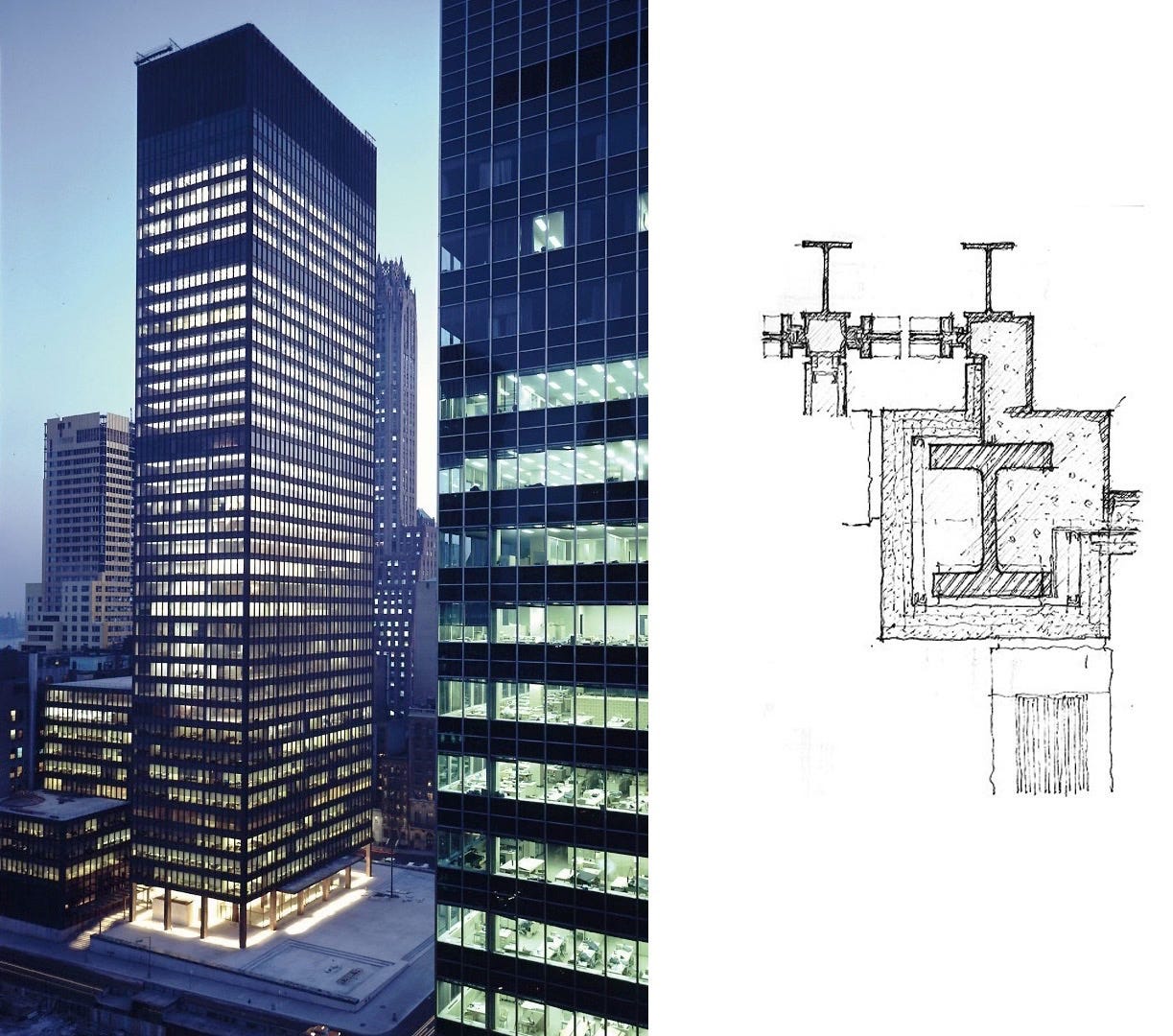
The Seagram Building (The slightly older Lever House is in the foreground, and a tower of concealing architecture is in the background left side). The detail of the skin of the building is definitive accomplishment, given that it was invented rather than taken out of the catalogue of possible configurations that we have now. It is bronze with custom bronze ‘I’ sections. This does not evoke ‘less’ definitively. It is an elegant, specific ‘less’.
The Seagram Building is a complex expression of less ornament, less decoration; utilizing an early Modernist tenet already as part of the public sphere. Less is now ever less definitive of architecture, while more is also a bore, as we suffer from too much information and all manner of effects demanding more discipline to even make any sense of, more and more often to avoid or discard. Yet, most of us know that playing with more and being excessive can always be meaningful. The early visions created by Midjourney were monstrous decorative willful creations. On the one hand they showed ignorance of structure and cost, yet the same images could cause me to wonder how narrowly we approach structure and form at all.
The Seagram Building is ultra-simple in structural terms. It is post and beam without even cantilevered elements, other than the projection at the entry porch. Yet, in the mode of ‘less is more’, the implications are more meaningful than a baroque Midjourney creation.
The plan section shows that the facade provides high value bronze ‘I’ sections spanning the facade’s vertical dimension. These are applied. There is no structural need for these. The window sections can be made take the lateral loads. In this case they were not, and those high cost vertical elements have structural purpose. It is a choice to apply those, and to give these custom solid bronze profiles the dimension they have, using very expensive custom bronze elements to communicate ‘lessness’.
The ‘less’ of the Seagram Building is as minimal means to presence architecture. Van der Rohe’s calculation of value does not include cost or time taken to build. It is not about structural needs or efficiency, excepting in terms of the technology of making those elements.
Inside that architectural skin is something actually quite monstrous. Like so much of our modern arts such as film and painting, horror is implicit. The interior is hall and box offices that have since become anathema to the life of worker-drones. The architectural value of the building is pushed to the facade, lobby and restaurant hall. ’Less is more’ does presence as architecture. It is poetry of the horror of garbage made in aspiring, unaware of what that myth implies.
Purity and efficiency are leitmotif of Mies van der Rohe’s work, as they are essential to spiritual practice. Realizing that in this building is anything but pure and technologically efficient.
That there is a relationship between architecture and spirituality means that they are not the same, nor do the same thing, but that they are a unified metabolism. Architecture must serve in that relationship.
Mies van der Rohe is not known to have taken up a spiritual path, yet one of his most famous statements reflects a principle that ties architecture to aspiration and to spirituality. Spiritual practice is to act on innate humility and courage to aspire the goal.
Nothingness. Definitions. 1. the state of being nothing; 2. something that is nonexistent: a view of humanity as suspended between infinity and nothingness; 3. lack of being; nonexistence: The sound faded into nothingness; 4. unconsciousness or death: She remembered a dizzy feeling, then nothingness; 5. utter insignificance, emptiness, or worthlessness; triviality: The days followed one another in an endless procession of nothingness; 6. something insignificant or without value;. 7. “What is really the substratum of existence? The molecule says, “I am”. The atom says, “Without us, you could not exist.” The nucleus says, “I am the one around which you electrons are rotating. I am the substrata.” And from the nucleus comes so many voices - the proton and neutron, for example. And from them come voices - particles of matter. Ultimately, if you keep going back to the sub-stratum of the universe, somewhere you will come to a particle in which there is nothingness. And that is the substratum, which is God forming the base.” P. Rajagopalachcari. Revealing the Personality. 1993. p. 144.