


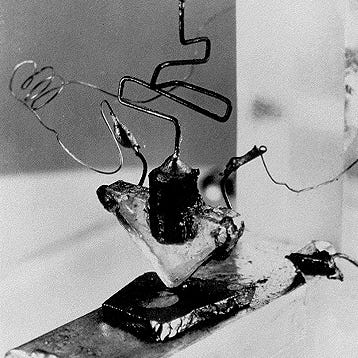
This project is a prototype. A prototype is a beginning, like starting with a colossal first functional transistor. Billions of them now fit in a device. After-technology architecture is a beginning. Once the knowledge for presencing architecture1 in environments as the profession’s raison d’etré is more available within the public sphere, it will become a power.
This proem is a personal introduction on this heartfelt project. I have done this for those of us seeking inspiration for new ways and for myself. This project is done as I would do it for an architectural project, which I explain below. It allows me to re-enter practice with a clear heart based on developing a paradigmatic foundation.
One of these OPA Substack articles may click with you, the next may not. I remain sanguine and understand that not every writing is always valuable to every person. I have read many great architects’ works that are truly difficult. I am an architect, so my thinking is spatial. As an architect I am good at proximities and multiple simultaneous relationships in space and time. To express such relationships through a strictly linear mode, not so much. I apologize for my limited abilities.
The whole of G¡a will connect and create for you an image of the future. Your path may differ, but the image of the future will hold.
This project of architecture straddles two areas of expertise that are almost never united on equal terms. Spirituality and architecture are ancient. Architecture has a ‘beginning’ only if human consciousness does. They are both ‘original’. Born of human consciousness, they both exist within it. Architectural and spiritual practice are twins and more than siblings. They are neither identical nor dizygotic twins. They are equals, where spirituality comes first, and is love, and architecture is its doting, loving sibling. Our consciousness is reflected in them in two realms; one inward facing and the other is outward facing. Practices and the objects of both spirituality and architecture document our highest values and the most esteemed elements of our lives.
My career has shown that this pairing is thwarted at every turn in practice. Business concerns of practicing architecture seem to be a conundrum of facilitating a livelihood in opposition to what architecture needs to be. Layers of personal experience have built up in me
that allow questioning of this relationship
while remembering politics and economics and other social relationships of all sorts,
and the relationship of humanity to the Earth that it is part of;
while understanding heroes and war …
to catch all the fragments and the anomalies,
to unwind layers of complexity and confusion, only to accept them as they are, and
to approach the heart and enliven ultimate human/e values.
Unity in architecture and spirituality is possible because it is true, but our present condition has pushed that relationship toward estrangement, as crazy as that seems. It is fitting for our increasingly crazy times.
Since beginning spiritual practice, my human relationships have become more heartfelt and my relationship to nature has become more important. The need for personal harmony with my architectural practice increased. It is a natural impulse for me to attempt to unify these values. Engaging my individual responsibility to myself, and the value of my life–time is personal.
Here are key questions: Can the conflicts borne in the profession of architecture be relieved by asserting architecture as formed by Nature through humanity’s consciousness? Can a profession be based in the unity of architecture and spirituality to serve the evolution of our consciousness that we aspire?
G¡a as Architectural Project
Taking change into our hands is part of architects’2 capacity. Architects make environments, proactively being part of the change humanity makes in the world. G¡a is my response to this, as an architect, taking up the questioning needed for paradigmatic change for the profession. This architectural project applies architects’ capacity to form our professional environment to ‘house’ practice more appropriately in a professional locus, as it needs to be.
I have taken on this project to do what a built project to provide architecture at a locus cannot. Individual projects are one instance at a time at a locus that allows intentions to be realized specific to a context. Architecture as practice exists as a very great field of knowledge that addresses community and collectives, the public sphere and egregores, and Nature. A locus of architecture has that whole within. This project forms what happens as the profession’s potential. The profession is a public locus for architecture’s superordinate program and architects who set out to provide its outcomes within Nature. This project is an architecture of the profession to be ‘realized’ in the public sphere.
A key characteristic of architectural practice is that it does not have the scientific characteristic of seeking scientific objective true results. There is no one way to make an environment. Our work is to discern a right approach and then to make it true. This tends to create an inclusive informational space and a potential for a massively expanding field of options, parameters and paths. Managing this is a key aspect of the work of a practicing architect’s genius, and it is what strikes fear into the hearts of many people.
The means to build architecture partakes of building technological responses that are formed by the science behind what they are to do. This often limits the options we see. Dogma of finance, economy and regulations that require time and power to change, often structure limitations at the very outset of a project. Every project has multiple choices that lead to multiple product and process options that are formed by many parameters. Even here, making choices in design is never a single objective right answer. It is not science to use a narrow set of data to limit and to devalue what science does not measure. That is how science works in our culture, and that is not beneficial to architecture or practicing architects.
This project is for paradigmatic change through current professional practice as it is formed as technology and building, which remains for now our path to realizing projects. But it asserts architecture’s values beyond technology. We take on suppositions to boldly include what does not initially seem to fit.
The Scope of Architectural Professional Practice
Architecture’s nominal purpose and goal is to provide architecture. What is actually architecture is today unresolved. The profession has an ongoing struggle with the value of business management and design and what being a professional means. A select small group and a few inspired projects featuring ‘new’ forms of building, process and technology of the future appear to satisfy a complacent rank and file to maintain the profession that remains grossly deficient in the scope that we claim as the profession’s. The definition of architecture in the profession and the scope of the professional’s work are deeply problematic.
Architects brave the struggle of achieving high value outcomes, while the channels of the current profession’s practical operation, appear stable and traditional. Dependence on work and values that are not exclusively architecture’s scope, but define the profession’s current mandate, presented as architecture, are mainly juxtapositional at the void where our real mandate is absent. The professional mode of practice seems to be disjunct3. The profession has become a dogmatic institution to facilitate confident assertion of competence in realizing built projects posed as architecture. Claiming that building is architecture, cushioned within a curiously banal daily process, makes practice often seem uncanny.
The narrow questioning of the profession has remained the same for a long time. The skill of proposing ever better questions about the architectural profession and practice make most professional and educational spaces and discussion panels dull, if not pathetic. This is only partly due to a lack of daring to provide answers. Multiple generations of architects have been posing similar questions challenging the Modernist Machine Ages profession and answer those with the more of the same questions to shore up a professional culture of dogged consensus.
This can go on because the essential role of architecture in humanity, and the need for what it would do, sustains the profession and keeps it vital with the Nature’s flow of the same energy in human life that makes Nature itself inexhaustible. This is power that can allow architects to feel complacent, rather than seeking growth and evolution. The suppositions posed in G¡a intend to supersede that same questioning of known flaws and anomalies.
The need to for change in the profession is gaining in intensity, however, as its fortunes sink. Repetition and doubling down on current values express that those old questions have no answers, only remediation. Little change to the issues and no fundamental change to the parameters of the profession must itself be a source of information about the problem. G¡a gets a toe hold here.
This Project
This architectural project sparkles with embedded technic and method. G¡a intends to contribute to forming ground to expand the professional mandate of architectural practice and allow a wider valuative impulse to take place. That demands that we define what that value / field must be. In a project uniting architecture with spirituality, one prepares to face the threshold where the material, the reasoned and extroverted evidence extends our touch into the unmeasurable and the immeasurable, just as any architectural project does. This is not out of reach for any of us. We are all and live daily the unmeasurable and immeasurable. The need for architecture, as in spirituality, is to include what is beyond the rational, on into subjective experience. We all have our experience together and share what is true. The experiencer becomes more important. This is the realm of spirituality.
Although many architects have no intention of expressing spirituality, it is often possible to find this in their architecture. Ruskin, or Pugin, Christopher Alexander or Louis Kahn, do their work accordingly to provide for architecture that has spirituality in its tight orbit. So, for example, the work of Rem Koolhaas is included. We do experience architecture, but it is today a profoundly undeveloped sphere of knowledge.
To ‘think’ like an architect is to allow the experience of feelings and insights to remain active and let them brush against what is done to be discovered as knowledge that is revealed as architecture, which everyone participates in together. Dwelling is superordinate to what is materially ‘constructed’ in world in this way. That is what presences as architecture. No activity of dwelling in the world can be exclusively material. There is no escape from this escape from the material into our hearts’ valuation.
Yet, we cannot work from outside dwelling. It is necessary to state the obvious — that we are alive in this life, in this form. We are in it until the end. So gaining an exterior to attain objectivity seems to be kind of nuts. G¡a shows how the objectivity of technology and its sciences is limiting, remaining within a narrow realm. Our consciousness exists at two realms; one inward facing and the other is outward facing that are necessarily included in projects of architecture. Realms and ‘worlds’ that are not material and have no sensible evidence are part of this.
A feeling is not something we can prove, and it is also not something that we can disprove. It does not mean that something does not exist, only that science cannot investigate it. Architects do. Architecture is something that we can ascertain beyond the material sensible life, with no data of measure. The realized form presences our aspiration, and architecture is a form of measure. G¡a forms a point of view that architecture is about awareness that is beyond measure and within human knowledge. This leaves us a lot of opportunity.
This project seeks to be a work of architecture at alocusof profession to be experienced by the reader. It is no philosophical work, just as it is not science. Just as science does, however, philosophical work informs our approach. This project does not reach for the ragged ends of philosophical digging in obscure corners. Heidegger’s work for example, is widely accepted and backed up by an industry of Heidegger scholarship. Your open mind is requested where questioning materialism and current technology and its sciences may seem to involve great leaps, and where novel juxtapositions of elements that are traditional or opposed occur.
Questioning the Techno-Profession
To question technology’s reign within architecture might seem for many of you to be a breach. Technology is after all the bread and butter of most architects’ business. Architecture existed long before, and it was never dependent upon technology.
How we use technology and its sciences today is a reflection of our inner human condition. Technological requirements can be a way to avoid personal experience of being human/e. This is a critical issue in architectural practice, in the structure of projects and their outcomes. It is implicated by the qualification that the architect be ‘of good character’. If we unpack that, a person’s status consciousness is not far from consideration. The means of architectural practice is foremost the architect. Removing the hindrances anyone faces in their inner life (i.e. through spiritual practice) is the same as what architects must do now to reveal the architecture that it may presence.
No matter how irrelevant or nonexistent or not-perceptible or concealed spirituality may seem, it is a formidable part of all areas of human life. No matter how irrelevant or nonexistent or not-perceptible or concealed architecture may seem, it is a formidable presence in all areas of human life.
We are always free to proceed even if science or a technologist is unable to verify spirituality and its parameters, for neither can they define architecture, life, love and feelings, all of which most clearly exist. The result of experience is as valid as any science. Critical thinking will not be lost where spirituality is in play. Moving away from dependence on technology will create the unconcealing definition of architecture and add responsibility for the professional architect that is tremendously important to humanity, to conscious wellbeing and to nature. It will provide for a huge increase in the fortunes of practicing architects.
The Goal in Architecture is a project of two commonly accepted children of consciousness as a step toward realizing their unity in practice to realize the superordinate program of architecture anew. It forms a strategic scaffold. It can be built out, verified further and developed in practice. Architectural practice can be joyous in hopeful provisory totality that absolutely includes all that may be.
As I take on contributing this work to address architecture and the profession from the point of view of architectural practice, I need to train and struggle for whatever it is. I have turned the corner toward a new stage in completing it this way.
See G¡a N.4 — Defined Terms for the G¡a project’s definition of ‘presencing architecture’.
See G¡a N.4 — Defined Terms for the G¡a project’s definition of ‘architect’.
See G¡a N.4 — Defined Terms for the G¡a project’s definition of ‘disjunct’.